
Emergency Garage Door Repair Near Me: What Washington Homeowners Should Do First
A broken torsion spring stores anywhere from 100 to 300 foot-pounds of tension, and that stored energy doesn’t care how inconvenient your morning is. If your door won’t open, stop before you touch anything. The first ten minutes decide whether this stays a repair or becomes an injury. Check the door from a safe distance, keep your hands off the springs and cables, and call (844) 372-0752. We answer 24/7, with fast dispatch from 7am to 7pm, Sunday through Friday.
Most homeowners who call us in a panic have already tried to lift the door by hand or yanked the red cord. We understand why. But knowing which part actually failed, and which parts you must never touch, changes what you should do next. Here’s how to tell the difference and when to step back.
We specialize exclusively in garage doors, which means we’ve seen the same three failures over and over. They don’t look the same, and they don’t call for the same response.
What Can You Check From a Safe Distance?
You can identify most garage door failures without touching the door at all. Stand back, look at the hardware along the tracks and above the door, and listen. The pattern you see tells you whether a spring, cable, or opener has failed, and each one calls for a different first move.
Here’s what to look for:
- Spring failure: Look at the torsion spring mounted on the shaft above the door. A snapped spring shows a visible gap where the coil has separated. The door may still be fully closed. A spring break is the most common reason a door won’t move at all.
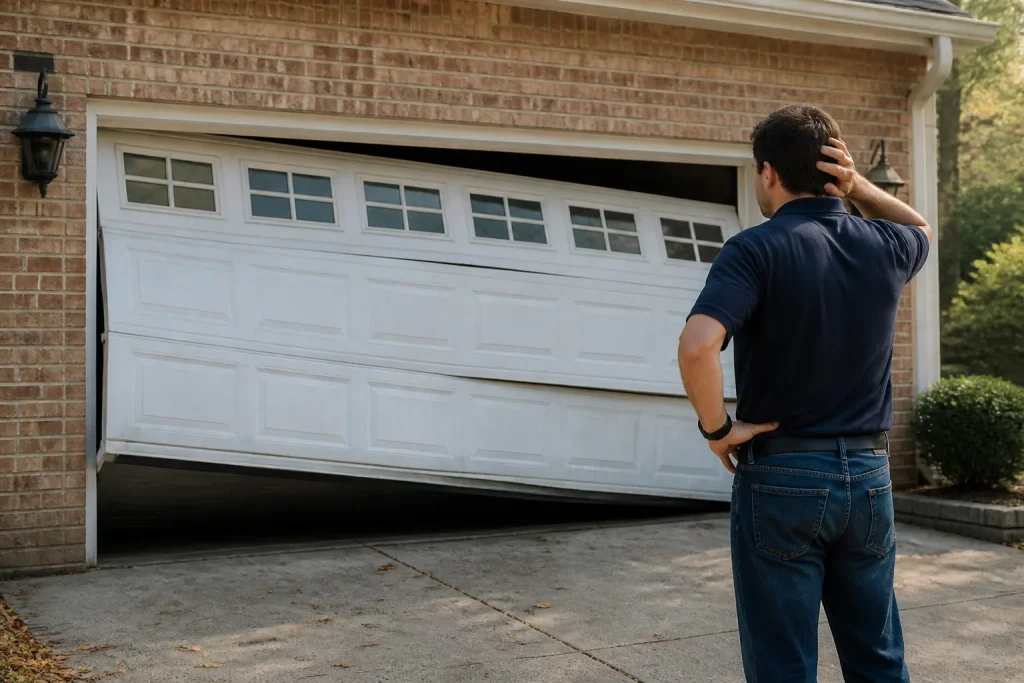
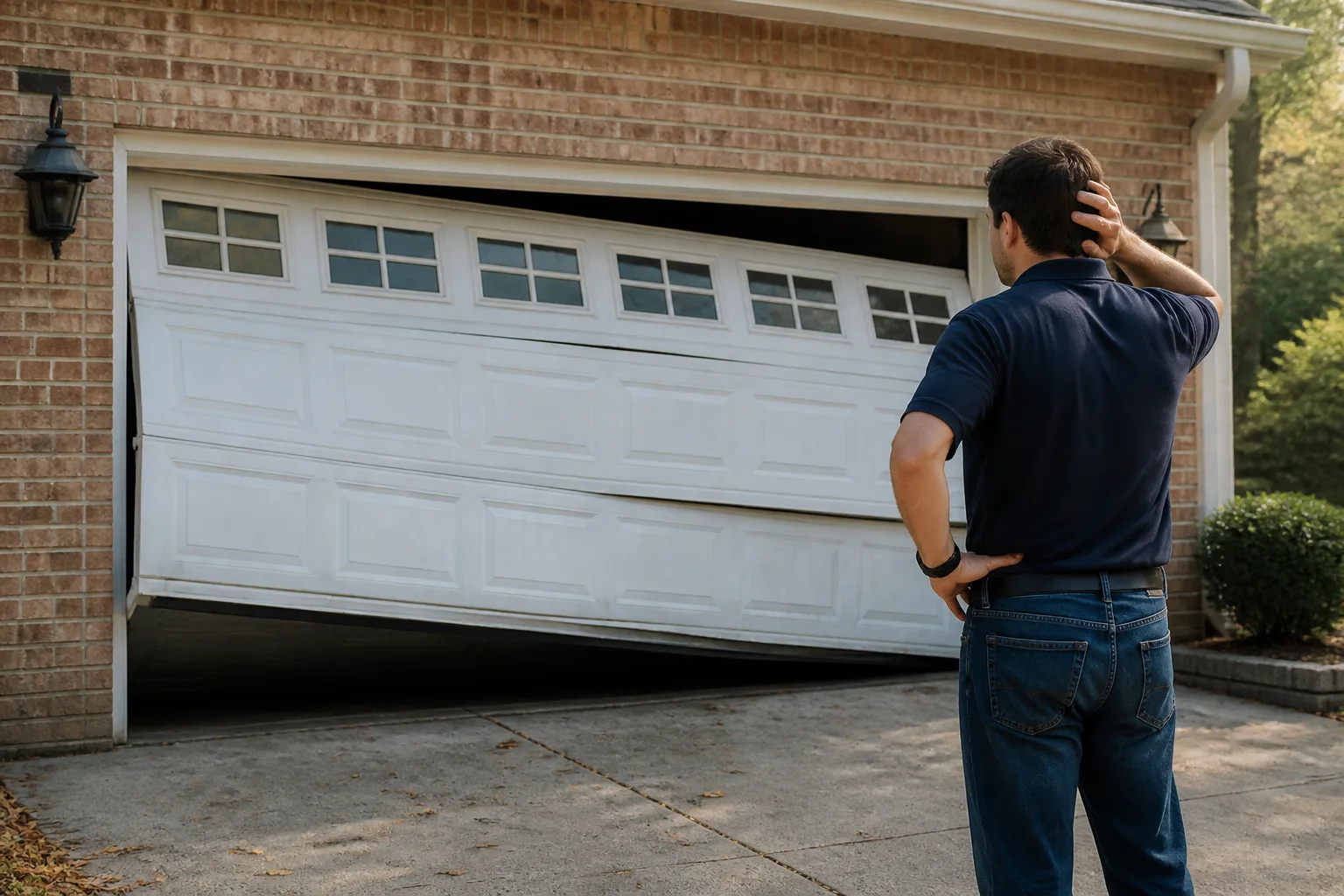
- Cable failure: Cables run along the sides of the door. A cable that has come off its drum will look slack or will be hanging loose and tangled. You may see the door sitting crooked, with one side lower than the other. Never try to reattach a cable yourself.
- Opener failure: If the door is down and the opener runs but nothing moves, or the motor hums without lifting, the problem is likely the opener, its drive gear, or the safety sensors. The door should still open with a proper manual disconnect and a healthy spring system.
Do not assume a door that feels heavy just needs a stronger pull. That heaviness is the spring telling you it’s already broken. In Washington, where so many garages are attached and shared with the house, a door that won’t close properly also affects the security of the whole property. For a closer look at how we handle these specific failures, see our garage door repair service.
How Do You Use the Manual Disconnect on an Opener?
The manual disconnect is the red cord hanging from your opener’s rail, and it’s designed to let you move the door by hand when there’s no power or the opener has failed. Pull it straight down toward the door, not toward the ceiling, and you’ll feel it release. That part is simple.
What comes after is where homeowners get hurt. Once the door is disconnected, the springs are the only thing making the door manageable. If the door is extremely heavy, it should tell you the springs are compromised. Here’s the test:
- Stand at the center of the door with a firm two-handed grip on the bottom edge.
- Lift slowly. A door with working springs should open with modest effort and stay wherever you leave it.
- Let go at roughly waist height. A sound door stays put. A door that slides back down has a spring problem, and you should not continue.
If the door won’t stay up on its own, do not prop it with a ladder, a broom, or anything else. A propped door can drop without warning, and the door itself can weigh several hundred pounds. The only safe answer is to leave it down and call. We handle opener issues specifically through our garage door opener repair page if the motor is the culprit.
What If the Door Is Your Only Way Out of the Garage?
In Washington, a lot of homeowners rely on their garage as the primary route between the house and the alley. If the car is trapped and the door is your only exit, a stuck door suddenly becomes a bigger problem than a broken spring. The good news is you usually have options that don’t involve touching the door.
Here’s what to consider:
- The pedestrian door: Many Washington garages, especially those facing alleys, have a standard walk-through door. If yours does, use it.
- The alley: If your garage opens onto an alley, you can move the car by hand rather than by motor, provided the door is already open. If it’s down, don’t force it.
- Street parking: Move the car to the street if you can safely reach it. Street parking in Washington comes with its own rules, so check the signs before you leave the car overnight.
- Neighbors and access: If your car is blocked inside, a neighbor with a shared alley entrance may be your fastest short-term solution.
What you shouldn’t do is try to muscle the door up over a car you’re sitting in, or ask someone to hold it while you drive out. A failing door can come down with enough force to damage the vehicle and the person below it. A working garage door is a convenience; a door on the way out is a hazard.
What Should You Tell the Dispatcher When You Call?
The difference between a fast fix and a long wait is often the information you provide on the phone. When you call, we want to know exactly what the door is doing, because it determines which parts we bring. The more precise you are, the less likely a second visit is needed.
Have these details ready:
- What the door is doing right now: fully closed, fully open, half open, or crooked.
- Whether the motor runs when you press the remote, and whether the door moves at all.
- Any sounds: a bang, a snap, a hum, or grinding.
- The brand of the door and the opener if you know it. We’re factory-familiar with LiftMaster, Chamberlain, Genie, Clopay, Amarr, Wayne Dalton, Craftsman, and Raynor, so we already know the quirks and failure patterns on those systems.
- What you’ve already tried, honestly. If you pulled the red cord, say so.
One of the reasons we keep our focus narrow is that we don’t need to guess. If you tell us it’s a Wayne Dalton door with a LiftMaster opener, we know what we’re walking into before we arrive. That’s what “already know your brand before we arrive” means in practice.
One homeowner we spoke with described it perfectly: the more they explained, the faster the technician could match parts. This is why we don’t split our attention across plumbing, HVAC, or electrical work. Every part we carry is for a garage door.
When Should You Not Touch the Door at All?
There are three situations where the safe choice is to leave the door exactly as it is and wait for a technician, no matter how inconvenient it feels. Each has a mechanical reason behind it, and each protects you from injury.
- You see a broken spring. A failed torsion spring can release stored tension suddenly. The door may look stable, but the tension is already loaded. Any attempt to lift or turn the door can cause the remaining spring to fail and the door to drop.
- You see a loose or hanging cable. A cable under tension can whip with serious force if it lets go. Never try to reattach one, and never pull on it to see how bad it is.
- The door is visibly crooked or off its track. A door that’s hanging unevenly is already out of its correct alignment. Forcing it up can bend the panels or bring the whole door down. That’s the moment where a small repair becomes a full replacement.
We realize waiting is frustrating. But a door that’s off-track or spring-broken is a safety issue, not a willpower issue. This is the moment to call a professional. Our team at Stratford Garage Door Service handles the whole system, from the spring to the opener, and we give you a free estimate before any work starts. The price is agreed in writing before we touch anything.
Related services in Washington: if the issue turns out to be the opener or the door itself rather than the springs, we cover both through garage door opener repair and installation across Washington.
The Bottom Line
The first ten minutes of a garage door emergency matter more than most people realize. Here’s what to remember:
- Check the door from a safe distance before you touch anything.
- A broken spring, a loose cable, or an off-track door means stop and call a professional.
- If the opener is the issue and the springs are healthy, the manual disconnect is your tool.
- Never prop a door that won’t stay up, and don’t drive out from under a failing door.
- Tell the dispatcher what the door is doing, what you’ve tried, and the brand if you know it.
We’ve been serving Washington since 2015, and garage doors are the only thing we do. It’s a narrow focus, and it’s the reason we can diagnose a failure quickly and carry the right parts. If you’re in Washington and need help, Stratford Garage Door Service offers free estimates. Call (844) 372-0752. We answer 24/7, with fast dispatch from 7am to 7pm, Sunday through Friday.
Frequently Asked Questions
The cost depends on what failed: a spring, a cable, an opener, or the door itself all price differently. We give you a written estimate before any work starts, and the written estimate sets the final price. Call (844) 372-0752 for an exact quote. Estimates are free.
In many cases, yes. We answer 24/7, with fast dispatch from 7am to 7pm, Sunday through Friday. If the call comes outside dispatch hours, we book it into the next opening. Call (844) 372-0752 to get on the schedule.
No. We inspect the door, explain what failed, and give you a written price before we start. The estimate is based on the actual condition of your door and opener, and that written number is what you pay. Call (844) 372-0752 to set up a free estimate.
Don’t. A door with a broken spring or a loose cable can drop suddenly, and the force is enough to cause serious injury. If your only exit is blocked, use a pedestrian door or move the car to street parking if it’s reachable. Then call (844) 372-0752 for a free estimate.
Written by the team at Stratford Garage Door Service, serving Washington since 2015.
Need Garage Door Help?
Call Stratford Garage Door Service - licensed & insured, here with fast help in Washington.
(844) 372-0752